
Castle Dragonheart
Castle Dragonheart is the palatial royal seat of the Kingdom of Senera and its reigning House Dragonheart. It stands above Thrantorbury on a magically carved mountain shelf. Its site previously served as the residence of the Kalassarian governor of Seneria and was intended to receive the Emperor as well as accommodate the provincial government.
Site Plan
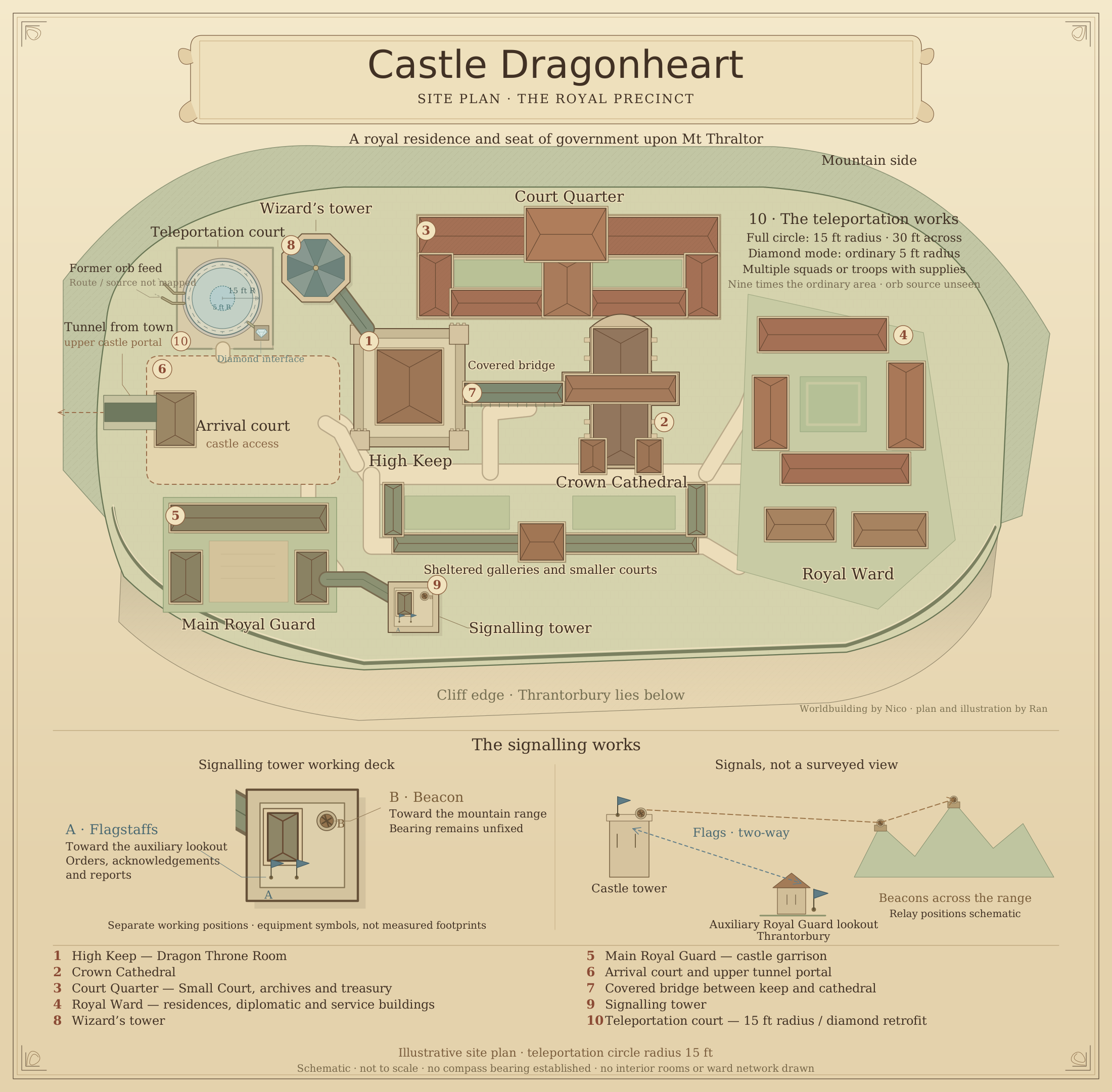
Section titled “Site Plan”Worldbuilding by Nico; plan and illustration by Ran. The site plan and signalling diagrams are schematic, not a measured survey or room-by-room floor plan. The teleportation circle’s 15-foot radius is established; other footprints, bearings, and exact underground routes are illustrative or unestablished. Its smaller diamond-powered opening is centred for comparison, not as a fixed equipment position. The original source orb and hidden conduit route are not shown. Open the editable SVG master.
Site and Approaches
Section titled “Site and Approaches”The castle occupies the higher of two inhabited shelves on Mt Thraltor. The mountain’s highest summit rises behind the royal seat; the castle itself does not stand at the summit. The Kalassarians carved its terrace, while the local mathrantorgralok carved the separate, lower plateau occupied by the town and university district.
The Crown Road climbs the exposed mountainside from the direction of Surrey-on-the-Brams, entering Thrantorbury through the Crown Gate. The principal onward approach to the castle is a tunnel through the mountain, not a continuation of that exposed ascent. The Crown Gate and the castle-access checkpoint are separate thresholds.
The royal seat is distinct from the Haven on Senera’s western coast.
History
Section titled “History”Kalassarian Residence
Section titled “Kalassarian Residence”Under the Kalassarian Empire, Senera was known as Seneria. The predecessor of the present castle complex housed its governor and provided for the Emperor’s accommodation should he visit. Imperial residence, provincial administration, and defense were therefore part of its purpose, rather than comforts added to a purely military fortress.
The Kalassarian design combined magical spectacle and magical fallbacks with durable physical engineering. Its tunnel and carved terrace express this combination: magic made substantial works possible, while their ordinary operation need not depend entirely on an uninterrupted enchantment.
The Royal Complex
Section titled “The Royal Complex”The royal complex includes structures associated with both the Maidenfeld and Dragonheart periods. The High Keep predates Dragonheart rule, while the Crown Cathedral belongs to the dynasty’s early reign. These later royal elements form part of a site whose use as a seat of government reaches back to the imperial residence.
Principal Divisions
Section titled “Principal Divisions”High Keep
Section titled “High Keep”The High Keep is the ancient stone fortress associated with the Maidenfeld period. It houses the Dragon Throne Room and remains a distinct part of the larger palatial complex.
Crown Cathedral
Section titled “Crown Cathedral”The Crown Cathedral was built during the early Dragonheart reign in the architectural tradition of the Orthodox Church of the Divine Masochist. A covered bridge connects it to the keep.
Court Quarter
Section titled “Court Quarter”The Court Quarter contains the Small Court chambers, royal archives, treasury vaults, and administrative offices. It serves the business of the royal government as well as the residential and ceremonial functions of the site.
Royal Ward
Section titled “Royal Ward”The Royal Ward contains noble residences, diplomatic quarters, guard barracks, and service buildings.
Wizard’s and Signalling Towers
Section titled “Wizard’s and Signalling Towers”The complex includes a wizard’s tower and a separate signalling tower.
The signalling tower uses flags for short-range communication and beacons for signals across the Ranterg Mountains. Its flagstaffs communicate with the lookout at Thrantorbury’s auxiliary Royal Guard base. They carry general orders for the castle garrison and relay orders to the Guard below; acknowledgements and reports return from the auxiliary lookout. This avoids sending every message through the castle tunnel.
Flags and beacons serve in place of a Kalassarian signalling system that was probably magical and has not yet been rediscovered. The local flag link and the beacons’ longer-range outlook have different sightline requirements; the diagrams do not establish surveyed bearings or the locations of relay stations.
The Castle Tunnel
Section titled “The Castle Tunnel”A large arch in the mountain face at Thrantorbury opens onto the magically created tunnel that provides the principal route toward Castle Dragonheart. Civilian streets gather near its approach, but a controlled Royal Guard buffer separates them from the tunnel mouth. Facilities there inspect castle-bound goods, services, and visitors.
The tunnel is neither dank nor stifling. The Kalassarian magical engineering corps cut numerous small air passages to provide ventilation through ordinary airflow. Non-magical lamps can burn steadily inside without their flames dimming for lack of air. The excavation is a magical engineering work; its ventilation is not a continuously maintained enchantment.
Teleportation Court
Section titled “Teleportation Court”The castle’s large teleportation circle has a 15-foot radius, spanning 30 feet across. Its full transfer area accommodates multiple squads or troops accompanied by supplies, rather than only a small group packed closely together.
The imperial installation was originally fed through conduits connected to a large Orb of Enhancement. It has since been adapted to consume diamonds as a substitute power source. The retrofit does not restore the full imperial transfer area: diamond-fed operation is limited to the ordinary Teleportation CircleLevel 5 · Conjuration1 minute · 10 ft. · 1 roundV, MAs you cast the spell, you draw a 10-foot-diameter circle on the ground inscribed with sigils that link your location to a permanent teleportation circle of your choice whose sigil sequence you know and that is on the same plane of existence as you. A shimmering portal opens within the circle you drew and remains open until the end of your next turn. Any creature that enters the portal instantly appears within 5 feet of the destination circle or in the nearest unoccupied space if that space is occupied. Many major temples, guilds, and other important places have permanent teleportation circles inscribed somewhere within their confines. Each such circle includes a unique sigil sequence—a string of magical runes arranged in a particular pattern. When you first gain the ability to cast this spell, you learn the sigil sequences for two destinations on the Material Plane, determined by the DM. You can learn additional sigil sequences during your adventures. You can commit a new sigil sequence to memory after studying it for 1 minute. You can create a permanent teleportation circle by casting this spell in the same location every day for one year. You need not use the circle to teleport… spell’s 5-foot-radius opening and brief portal window. The full circle has nine times that opening’s area.
Creatures already standing within the active area are transported when the circle activates. Additional travellers can enter before the opening closes. Capacity depends on the active area, the load, and the opportunity to enter, rather than a fixed passenger count.
Architecture and Defense
Section titled “Architecture and Defense”Castle Dragonheart is a defensible seat of government and a palatial residence, not simply a ring of high curtain walls. Substantial wings, smaller internal courts, sheltered galleries, and protected entrances divide its functions and circulation.
The imperial defensive problem included teleporting intruders, magically flying casters, and mounted air cavalry. A cliff or tall perimeter wall could not by itself keep such opponents outside. Protected movement between buildings and internal divisions mattered alongside guards and magical protection.
The castle’s main Royal Guard complex is separate from the auxiliary military compound and lookout on the town plateau below. The town’s military base, the tunnel checkpoint, and the castle garrison have distinct locations rather than forming a single gatehouse establishment.
Structural support, ordinary enclosure, and military defenses serve different purposes. Retaining works support raised terraces or made ground where needed; the carved bedrock itself need not be faced everywhere with a retaining wall. Parapets and enclosures also serve safety, privacy, and access control without making every terrace edge a battlement.